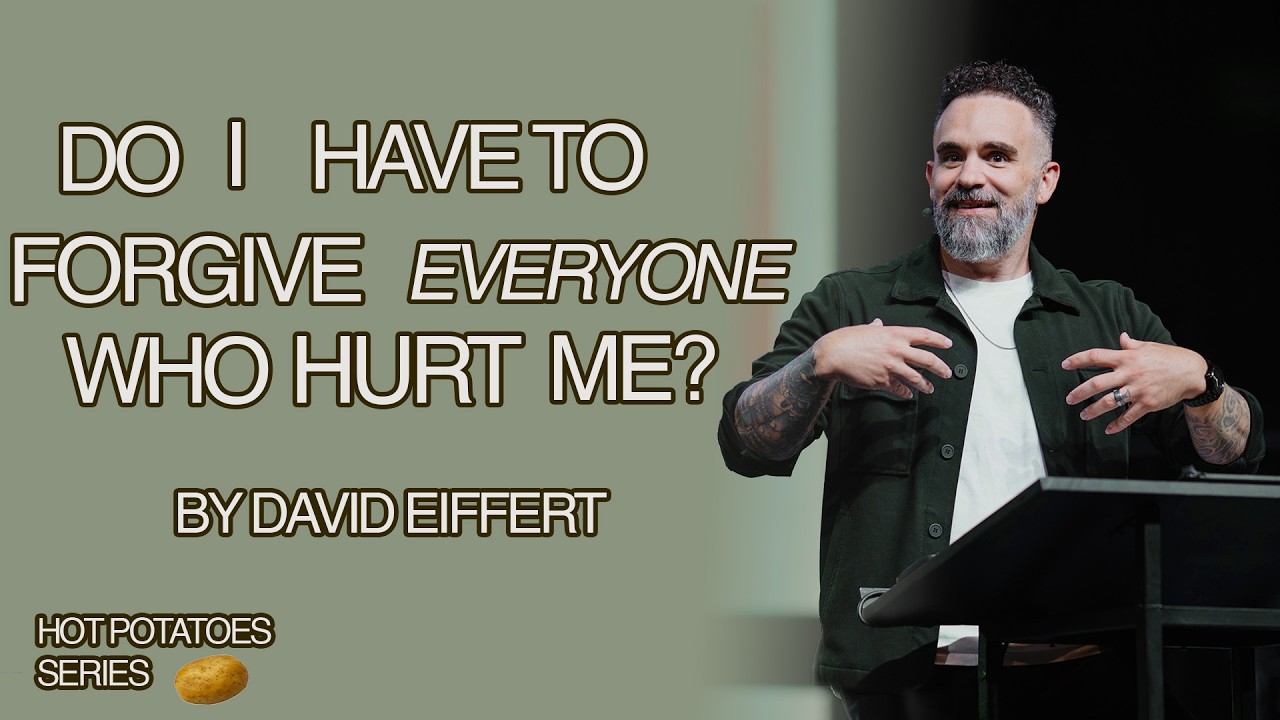
Do I Have To Forgive Everyone Who Hurt Me
Scripture
A message on whether you truly have to forgive everyone who hurt you, working through four objections (no apology, the offense was too bad, it means reconciling, it feels impossible) and distinguishing forgiveness from trust and restored relationship, framed as a supernatural work God empowers rather than an excuse for what happened.
Transcript
This week, my hot potato is this, and it’s a question: “Do I have to forgive everyone who hurt me?” Do I have to forgive everyone who hurt me? Some of you, I think when you read a question like that, immediately there’s a name that pops into your head, or maybe a couple different names. And some of y’all in here are reading a question like that, and you’re hoping that I’m going to let you off the hook and say, “No, you don’t have to.” Because you’re like, “Please don’t tell me I got to forgive them.” Not I forgive y’all, but I’m not going to forgive that guy. I’m not going to forgive her. Some of y’all though are thinking, and you’re hoping that maybe I won’t let you off the hook, because you’ve been carrying something for years and years and years and years. And maybe you’re finally ready to let go of it, but you just don’t know how. So wherever you’re at, I think this is a message for you.
The question, “Do I have to forgive everyone who hurt me?” I’m just going to jump to the answer. Are you ready? Here’s the answer. Yes. That’s the answer. Yes, but. Yes, you do have to, but it doesn’t mean what you’re afraid that means.
In fact, look at what Jesus says in Luke chapter 17. He says it to the disciples. He says this:
It is impossible that no offenses should come.
Isn’t that interesting? It’s impossible. He didn’t say it’s unlikely. He didn’t say, “Well, try to avoid it if you can.” He said, “Impossible.” Genie Mayo, one of my mentors, she would say, “There is always someone who will find a way to pee in your Cheerios.” That’s what she said. She would always say that. The truth is it’s like offenses are going to come. People are going to do wrong. Even if you move to a cabin and delete every app and talk to nobody, there’s still going to be someone that’s going to paddle a canoe up just to let you down.
So the question is never, “if I get hurt.” The question is always, “what do I do now?” And hiding in a very serious silly series is actually a really serious question. I can’t tell you how many pastors, me, Pastor Jordan, Pastor Cindy, Pastor Marshall, Pastor Sheryl, I can’t tell you how many people we have counseled that have made a total wreck of their life simply because they have not mastered a very simple and profoundly difficult principle, which is forgiving as you have been forgiven.
You just got to know this, that Jesus himself says, “People are going to do the wrong thing to you.” You will be hurt. And honestly, that seems like it’s bad news, but in a way, if you think about it, it’s kind of good news, because it proves that just because you have pain, it doesn’t mean that you did something wrong. It doesn’t mean that you necessarily picked wrong. It doesn’t mean that you necessarily made some relational error. It just means you’re a human and you’re alive and you live with imperfect people, just as beautifully imperfect and weird as you are.
So we are going to have an opportunity to learn how to forgive. The question is never “how do I keep from getting hurt.” The question is, “when I do get hurt, and you will, do I have to forgive them?” This is something that I tell people often. I’m sure you’ve heard me say it. I say it like this: if the Christian faith is not about forgiveness, it’s not about anything. Forgiveness is front and center to everything that we believe and understand and receive and practice as Christians. Forgiveness is how you got here. If forgiveness wasn’t a thing, you wouldn’t be in that chair. I wouldn’t be up here if it weren’t for forgiveness.
So forgiveness is not a tangent in the Christian faith. Central in the faith is learning to offer the forgiveness that you have received to other people. Jesus doesn’t say, “Forgive because I told you.” He says, “Forgive because I have forgiven you.”
To be clear, I’m preaching this not because I’ve mastered it, but I need to hear it too. And I do feel like I have some revelation on it, because just like you, I’ve lived on this planet for 43 years, and there’s some people that I feel have stabbed me in the back. You probably feel like there’s some people that have maybe stabbed you in the back. There’s lots of people who are like, “My ride or dies. They’ll be here forever, my whole life,” and then I’ll come and see them like five years later, they hate my guts. So I have to deal with that too. It’s not like, “Oh well, you live in the church, so it’s easy for you, you don’t have to ever forgive anybody.” Forgiveness is probably the hardest thing about this job. I’ve never said that. I’ve never thought about it, but I think that’s possibly true, that forgiveness might be the hardest part of being a pastor. Because it’s relationship all the time. Always dealing with people and trying to relate with people. And people have complexities and changes. Your heart changes and my heart changes. And then you think you’re supposed to be here and then you’re not supposed to be here. Or you said you’ll be here and you don’t show.
And notice this too, just let me point it out. Everyone up in here, you might say, “Not me.” Everyone in here has an opinion about me. There’s not a single person in this room who doesn’t have an opinion about me. And sometimes those opinions find their way to me, because you told my mom, and she tells me everything. Right? So I’ve got to learn to forgive too. Can you tell? I’ve got to learn to forgive too.
Objection one: “But they haven’t apologized”
When people hear the answer, “yes, you have to forgive,” a lot of people will come up with objections for why I don’t need to do it, or why this situation is different, or why this situation is uniquely complex. So I have for you this morning four objections, and we’re going to take them one at a time. These are objections to why you think you don’t have to forgive.
Number one: “but they haven’t apologized.” They haven’t said sorry. It’s a pretty good objection, I’ll say, because it’s a reasonable place to get stuck, because in your head you have a clear order of operations on how this ought to happen. They did wrong, so they go first, they own it, they say the words, they apologize, and then I’ll forgive. So you wait. And I get it, because I wait too.
As someone who has waited, I remember when I was in my 20s there was a guy around my age, and I felt like - it’s a long story and it’s dumb now - but I felt like he had done something wrong to my family. A believer. He didn’t see it that way, though, but that’s how I saw it. And I remember I had anger in my heart towards this guy in a way that I’ve never experienced up to that point, and I’ve never experienced since. He was a great guy, but I just let it fester. You know what I mean? The more you think about someone and less you relate to them, you can turn them into this huge caricature that is just so black and white, obviously a bad person. That’s what I did. I had resolved in my heart, because I was in ministry, I had resolved in my heart that if he comes and asks for forgiveness, I’ll forgive him. But until then, it’s World War III. It wasn’t even like I was trying to do something, I was just holding the line. I was just like, “You get nothing from me until you apologize.”
I remember I was thinking about it, I was praying about it, and I felt like the Holy Spirit came to me one time when I was praying about it, and he said this to me, and it was so clear, I never forgot it, I wrote it on the screen. I feel like God told me this: “You don’t need an apology to move forward.” And my first reaction when God told me that was, “I disagree, Lord. I do need an apology to move forward.” But it’s like, “No, no, I get it.” Because here’s the trap. The trap is that when you tie your freedom to an apology, you’re tying your freedom to a conversation that might never happen. Because in this life, you can only control one person, and that’s you.
And they should apologize. Right? What they did was real. I’m not saying they didn’t do something real. I’m saying they should say sorry. But even if they don’t say sorry, you can still move forward in your life, because it’s not about them, right? Some of us are waiting for an apology from people who are never going to give it. Others we’re waiting for an apology from people who don’t even know they did something wrong, or have convinced themselves that what they did ain’t that bad. It’s never going to come. Some of y’all, let me put this gently, are waiting for apologies from people who are dead. Outside of heaven, that is never going to happen on this side.
And this is what I’ve noticed. I don’t know if you’re like me, but I’ve noticed that sometimes people apologize and it makes it worse, because they apologize wrong. They say like, “Oh, I’m sorry that offended you.” No. You meant to say you’re sorry for being an idiot. Don’t apologize for how I heard it. It’s like, “Well, I’m sorry you’re so sensitive.” No.
I just think it’s important to know that your freedom can’t be held hostage by something that someone always has the choice to give you or not give you. I’m not saying they didn’t do it, and it wasn’t bad, and it wasn’t horrible. I’m just saying with God’s help, you can move on. You don’t want to give anyone that power outside of God himself.
So you’ve got to know that it’s like, yes, they hurt you, but think about it. They’re out there living their life. They’re not thinking about it. You’re thinking about it. They’re at a barbecue right now, and you’re just in there stewing and thinking that somehow you’re torturing them. It’s not torturing them, it’s torturing you.
Here’s kind of my turn in this point, you can write it down: you’re waiting on a sorry they may never give when you already have something better. Because underneath that hunger for an apology isn’t actually about the words. It’s not about them saying that. It’s about the debt being settled. Do you understand what I’m saying? When someone does something wrong to you, everybody understands, even kids, that there’s now a debt created. Let’s say you’re in elementary school and a kid comes and pours chocolate milk on your head. Well, what just happened? They owe you. And then maybe you go and pour milk on their head, then you’re even, then you’re cool. So even from a very young age, you understand that when someone sins against you, it causes a debt. So what you’re hoping for when you’re hoping for an apology is that somehow the debt will be repaid so that you can move on.
And the good news of the gospel is this: that the payback has already happened for you. Not from them, but from Jesus. You already got grace, you already got mercy, you already got your debt canceled. To be clear, they should apologize, I hope they do, but even if they don’t, you already got something that they could never give you anyway, which is wholeness from God. They could offer you an apology, but they can’t offer you forgiveness. Only Jesus can.
Objection two: “But what they did was really bad”
Number two: “but what they did was really bad.” It was really bad. And this objection, out of the four, it feels the most righteous, because it’s true. What they did was bad. And it feels like - forgiving, for some people, tell me I’m not the only one - it feels like, if I forgive you, then I’m somehow communicating that what you did wasn’t bad. Am I with you? Are you with me? There’s something on the inside of me that if I say, “I forgive you,” it’s like, “Oh cool, it must not have been that bad.” It’s like, “You’re saying it’s okay.” It wasn’t okay.
But let me show you something. Matthew chapter 18. Peter walks up to Jesus, he asks him a question. And Peter has already done some head math in this story. He’s already proud of himself when he comes up and asks this question. Matthew 18:21:
Then Peter came to Jesus and asked, “Lord, how many times shall I forgive my brother or sister who sins against me? Up to seven times?”
The number of divinity. Peter thinks he’s being big, because the rabbis of the day, they taught three. So he’s like, “I’m doubling that plus a tip.” He’s like, “Seven? What do you think, Lord? I’m basically a saint here.” It’s the same question that I think a lot of us ask, right? “How many times am I going to put up with this repeat behavior? How many times am I going to tolerate this and look past this and forgive this? There has to be an end to the mercy eventually.”
Jesus’s response, verse 22: “I tell you, not seven times, but 77 times.” Some translations say seventy times seven. There is some significance to that number in the Old Testament. There’s a song of Lamech that talks about revenge: “I will avenge, not seven times, but seventy times seven.” So he’s kind of riffing on that. But this is Jesus basically saying infinity. He’s saying, “As many times, you stop counting.” Because if you’re keeping a tally to forgive someone seven times - you know what he does the third time he sins against you? Number three. Number four. Number five. If you’re counting, you’ve got a notebook in your back pocket and you’re writing down what he did. I think, well, you probably didn’t forgive him at all.
So Jesus said, “Stop counting.” And then he tells this story that is ridiculous on purpose. The numbers are super silly in how big they are. Basically the story is this: there’s a servant, and the servant owes the king, it says, 10,000 bags of gold. 10,000 bags. This is billions and billions of dollars. Generational. This is a cartoon number, comically high. And I think the absurdity is intentional, I think Jesus is doing it on purpose. The king, for no reason at all but just because of mercy, goes and forgives it. He cancels the debt. And then the servant walks out and finds a guy who owes him like probably about $20. And he grabs him by the throat and starts yelling at him. It’s interesting in the story that it’s the same word, “debt.” It’s not a different kind of debt. The difference and the point of the story is a small debt and a big debt. That’s the idea, it’s the size of it. He’s been forgiven billions, but he’s unwilling to forgive $20.
And then the king finds out. Watch this, Matthew 18:34:
In anger, his master handed him over to the jailers to be tortured until he should pay back all he owed.
That’s a scary verse, right? So sometimes our instinct is like, “Yes, get him, Jesus, send him to hell.” But I think you’re identifying with the wrong character in the story. I don’t think that’s what this is saying. I think you can make bad theology from one parable that’s maybe trying to say something different. That’s my opinion. The servant has already been forgiven, past tense, it was already done. So I don’t think Jesus is threatening to unforgive you and send you to hell if you don’t forgive.
So what do you think the torture is that he’s talking about? For me the answer is pretty simple: unforgiveness is its own torture. The unforgiveness that you have - you think you’re imprisoning someone in front of you, but you’re imprisoning yourself. You think you’ve got somebody locked up, but they went home and slept fine. The only person still in prison is you.
At the gym - I go to the gym not as much as I should, but more than I’d like - I do this one exercise that’s very silly, it’s called a farmer’s carry. Does anyone know about the farmer’s carry? A few of the buff people in here, I’m not judging you if you didn’t raise your hand, you’re buff too. The whole idea is very simple: you hold two weights and you walk around. That’s pretty basic, right? You just grab them and you’re like, “Oh, this is easy,” and you walk, so you grab as heavy as you comfortably can and you just start making laps, or maybe walk around the gym, and you’re like, “This is so easy.” Give it a minute, because you’re about to start sweating. Your forearms are about to start burning, your traps are about to start burning, your legs are about to start burning. And it’s just interesting that as the time goes on, the weight doesn’t change, you do. The weight doesn’t get heavier, you get weaker as time goes on.
And I just think that’s how a lot of people live their life. You’re carrying something, and at first it doesn’t seem like that big of a deal. “I hate that guy. Man, I hate that guy. God, I hate that guy. Hate that guy.” It’s cool, it’s cool, yeah, it feels fine. But give it a minute. Give it a year. Give it two years. Give it five years. Give it ten years. And that weight, if it’s never dealt with, can crush you. And I’ve learned that if you’re carrying heavy weights everywhere you go, it’s real hard to play with your kids. It’s real hard to raise your hands in worship when you’re carrying heavy weights everywhere you go. It’s real hard to make a difference in the city when you’re carrying weight that you’re not meant to carry.
So the point is that unforgiveness is not about a punishment. It’s not a punishment for them. It’s a weight that you carry. Now please don’t hear what I’m not saying. I’m not saying it was small. I’m not saying you’re dramatic. When I forgive you, I’m not saying you’re right, I’m saying I need to be right. When I forgive you, I’m not saying you’re good, I’m saying I need to be good. I’m not saying what you did was healthy, I’m saying I need to be healthy. You can write this down: forgiveness isn’t a verdict on them, it’s a decision about you. You’re not saying anything about them, you’re saying something about you and how you’re choosing to move forward.
Choosing to forgive doesn’t mean it stops costing you. This is how it was taught to me, and it finally made sense to me: forgiveness is you fronting the bill to pay for something that you didn’t break. In Bible college I had a roommate, and we had a friend over, and he was playing with a ball in the living room. Boys are weird. He was throwing the ball and running to the other side of the room to catch it, he thought it was funny. I was like, “You’re an idiot.” But he kept throwing the ball, running, and catching it, and I’m like, “Yep, you better be careful, bro, you better be careful.” Well, he wasn’t careful, and his butt hit our lamp and knocked it over, and it broke. At that moment the lamp broke, the reality is one of us is going to pay for it. In that case it should have been him. It wasn’t, but it should have been. But that’s what happens when someone sins against you: someone will pay for that. And the question is, are you going to make them pay for it, or is forgiveness going to mean you fronting the bill?
I think it’s worth noting, and this was a revelation for me: when I decide that I’m going to front the bill for someone else, for something they broke that I didn’t break, I don’t get to pay that all at one time. I make payments, over time, over years, sometimes over a lifetime.
There’s a letter that I’ve read to you a few times, I think, but it’s a letter that for me really meant something when I read it. It was written to a pastor years ago, and I just want to read it to you. But focus on the idea of making payments over time when it comes to forgiveness.
Once upon a time I was engaged to a young lady who changed her mind. I forgave her, but it took me a whole year, and I had to forgive her in small sums over that whole twelve months. I paid those sums whenever I spoke to her and kept myself from rehashing the past. I paid them whenever I saw her with another man and refused self-pity and rehearsal inside for what she’d done to me. And I paid them whenever I praised her to others when I really wanted to slice away at her reputation. Those were the payments, but she never knew them. However, I never knew her payments, but I know that she made them. I could tell. Forgiveness is not only a refusal to hate someone, it’s choosing to love and will the good of the offender. It is painful, but wood, nails, and pain are the currency of forgiveness, just as Christ’s wood and nails were. It leads to healing, and more, to resurrection.
Objection three: “But forgiving means I have to let them back in”
Point number one, but they haven’t apologized. Two, but what they did was really bad. Three, but forgiving means I have to let them back in.
For some of y’all, it’s like you’re okay with the idea of forgiveness as a concept, as a topic that people talk about at church, but if you start talking about this, it’s a little different, because the person that hurt you isn’t a concept. They’re dangerous. Maybe they’re not sorry. Maybe they’ll do it again tomorrow. So when I say you have to forgive, what you hear is, “I’ve got to put my hand back in the fire, I’ve got to open the door, I’ve got to let them back in to do it again.”
Forgiveness isn’t that. In fact, you could write this down: forgiveness and reconciliation aren’t the same thing. Somebody needs to hear this. Forgiveness and reconciliation aren’t the same thing.
Because I follow Jesus, I’m going to love you without conditions. Perfectly? No, but that’s what I’m going to try to do. You can stab me in the back and I will at least endeavor to love you unconditionally. I will always be committed to your good and to your well-being, and it’s not dependent on you treating me right. I will do right by you, regardless, to the best of my abilities and beyond, because I love you. But that doesn’t mean that we have a relationship. And that’s just so important. It’s such a point of confusion that people get mixed up in. A relationship takes two people. Forgiveness takes one. Relationship takes two. It requires that they own it, that they change, that they become safe. And that part isn’t always possible.
So you’ve got to make the difference. You can write this down: forgiveness is granted, trust is earned. Forgiveness is granted, trust is earned. Forgiveness is a gift, trust isn’t. I don’t gift my trust to anybody. You can earn my trust, but I don’t give you my trust as a gift. It’s built by time, and it takes both of us.
Let me say this, that if you’re in an abusive relationship, we just always have to say this: if you’re in an abusive relationship, none of this is telling you to go back. You’ve got to hear that. And if there’s a pastor who’s telling you you should go back because you’ve got to honor your commitments, he doesn’t understand, he’s confused. God is not calling you to put yourself in an unsafe place for the sake of forgiveness. Forgiveness isn’t returning to someone who hurt you. Let me say it like this: you can forgive and leave at the same time. You can do both. “I love you, I forgive you, I’m out of here.” That’s great. More Christians need to learn to do that. You can forgive and leave at the same time. You can release them in your heart and still get yourself to safety, both at once. Sometimes you’ve got to forgive and block. I do that. You’ve got to forgive and unfollow. You’ve got to forgive and never speak again. “I’ll never talk to you again.” It’s not about forgiveness, because forgiveness is not about my relationship with that person, it’s about the posture of my heart and how I walk around and the weight that I carry or don’t carry. It’s not about them, it’s about me.
Jesus really makes this actually pretty clear. He tells a story, probably the most famous parable of all time, the parable of the prodigal son. If you don’t know it: the boy takes his money and runs off, and in doing so he’s basically telling the father, “I wish you were dead, I just want my inheritance.” So he goes, he’s sleeping in the pig pen, and everything’s going really poorly for him. And he comes back eventually, and I just think it’s interesting that in the story, the father had already forgiven the son when the boy was still gone. He had dealt with his internal hurt already. You’d think that would be hurtful? Yeah. But he had already done the internal work to forgive. He wasn’t replaying the fight in his mind, thinking of all the mean things he wished he’d said. Am I the only one? When someone hurts my feelings, I’ll fight them 48 times in my brain over the next two days, thinking of all these clever things I’d never actually have the courage to say. But he’s not doing that.
So the father had already done the heart work, but the relationship wasn’t restored until the son came home. Forgiveness came before repentance, reconciliation didn’t. This is important for you to hear: it’s like, “I forgive you, I love you, I’m committed to your well-being, I’ll honor you as my brother and sister in Christ, but reconciliation doesn’t happen until you change.” I’ll pray for you, but I can’t let you back in, because that’s not love and it’s not wisdom. That’s the model.
So you release them today in your heart. You don’t wait. You don’t need permission, you don’t need their apology. But restoration waits on repentance. And sometimes for your safety, it waits forever. That’s just a reality. But either way, you’re free. Either way, you’ve done what you need to do, so you’re not carrying the weight.
Objection four: “But I can’t”
Number one, but they haven’t apologized. Two, but what they did was really bad. Three, but forgiving them means I have to let them back in. Number four, but I can’t.
Out of all of these, this is the best one. You know why? Because it’s true. You can’t do it. You can’t forgive them, not on your own. Not white-knuckling it, trying to forgive. The disciples actually show us this. If you go back to Luke chapter 17 where we started, Jesus tells them, “Hey, you’ve got to forgive infinity times, not once, not twice, but over and over every time.” And their response, it’s so interesting what they say. They don’t say, “Aye, sir, right away, Lord.” Look, Luke 17:5:
The apostles said to the Lord, “Increase our faith.”
He says, “You’ve got to forgive infinity times,” and they say, “Well, then we’re going to need more faith.” “Infinity times? Oh, well, then we’re going to need more faith.” We don’t need to white-knuckle it more, we need faith. And they were right, because forgiveness is supernatural and it requires supernatural help.
I’ll tell you this has been true for me: I have found the end of forgiveness, where I’ve just tried to forgive and I’ve tried to forgive and I cannot get over it. I just can’t. It’s too close, it’s too real. I’m not talking about someone who stole your burrito. There are people in here that have been victims of their family members being murdered. In this room. That’s not a theoretical question. It was a big deal. I’m not saying it’s not a big deal. But I’m saying you can carry that your entire life and you don’t make it any worse for them, you just make it worse for yourself. But God can come and then he can help you. He can come and restore the broken things.
I love that the scriptures call God the great physician. He even understands every little thing on the inside of me. Because there are tiny little synapses and electrons and all of these different things that happen - I probably said a computer part in there accidentally - all of these different things that we don’t even understand. We understand such a tiny fraction of what makes a human tick. But God understands every single bit of it. So when you push, it’s like, “Man, I’ve got a block here, God. I’ve got a block. Something’s blocking in here. I can’t move past it. I wake up thinking about how much I hate that guy, I go to bed thinking about how much I hate that guy. Something’s broken here.” Only God the great physician can come in and rewire and fix things. He does it through his miraculous works. He also does it through the renewing of our mind through scripture. He does it through wise counsel. He does it through a lot of different ways. But God can come in and give you supernatural health and help and strength to move on.
And again, you give it not because he just told you to, you give it because you’ve got it. You give it because everything in the Christian faith - this is the way I say it - everything in the Christian faith is God, us, others. What does that mean? It means that God does something for us, and then we endeavor to do that for other people. God doesn’t ask us to do anything that he didn’t already do times a hundred. Everything that he calls us to do, he models for us to do, but also he empowers us to do by his grace. Pastor Marshall says all the time, grace is not just letting you off the hook, grace is empowerment. The strength to do what only God can help you do.
So that’s the model: God loves us, and because of that we endeavor to love other people. God is generous with us, and because of that we endeavor to be generous with other people. God forgives us, and so we endeavor to forgive other people.
Wounds and scars
As I close, forgiveness does not mean that the mark disappears. Some of you are thinking, “Man, if I forgave, I wouldn’t feel it anymore.” That’s not true. Healing and forgiving doesn’t mean it never happened. You can even see this in the life of Jesus. Jesus was killed brutally by people he came to give his life for, and he modeled forgiveness as they were in the act of killing him. He’s killed, he’s buried, put in a tomb, and then three days later he raises from the dead, and he walks into a room where the disciples are hiding, because they’re scared. And you know what he does? He goes up to them and shows them his hands. He showed them his scars.
Look at this, John chapter 20 verse 27, Jesus says:
Look at my hands.
And notice, it’s only been three days. It’s not that long for someone to have had a huge nail stabbed through their body. It’s not that long to still be wounded by that. But he didn’t have a wound, he had a scar. There’s a difference. Three days later, he’s not still bleeding, but he still had scars. And there’s a world of difference between wounds and scars. A wound means that something is still open and still bleeding. A scar means two things: there was real damage, and there was real healing. That’s what a scar means. A scar means there was damage, but it also means there was healing.
A scar isn’t proof that you didn’t forgive. The scar is proof that you got hurt and you got healed. So it’s like, one day, our hope for you is this: that you’ll be able to look at your scar and show someone your scar, and you can say, “Look at what happened, but look at what God did.” God can turn the wound into a scar, and then can turn it into a testimony. And then what you go through, what you had to go through, maybe you save someone from having to go through, because you let God come in and heal the things that imperfect humanity broke, and he can turn it around for good.
Closing
Do I have to forgive everyone who hurt me? Yes, but that doesn’t mean what you’re afraid it means.
One, but they haven’t apologized. Your freedom can’t be held hostage by an apology that may never come. You’ve already received from Jesus something they can never give you.
Two, but what they did was really bad. Forgiveness doesn’t call it okay. It’s a weight you set down instead of carry, so you can move on.
Three, but forgiveness means I have to let them back in. Forgiveness brings closure, it doesn’t always bring restoration, and that’s okay.
Four, but I can’t. Forgiveness is supernatural, and it requires supernatural help. Help that God is ready to give.
Can I get a good amen?